| Version 27 (modified by , 17 years ago) ( diff ) |
|---|
Testing of MDS image quality - Durham (Jim Geach)
I have been looking at fields MD07 and MD08, checking out image quality, and trying to highlight potential issues that will affect extragalactic science.
General image quality
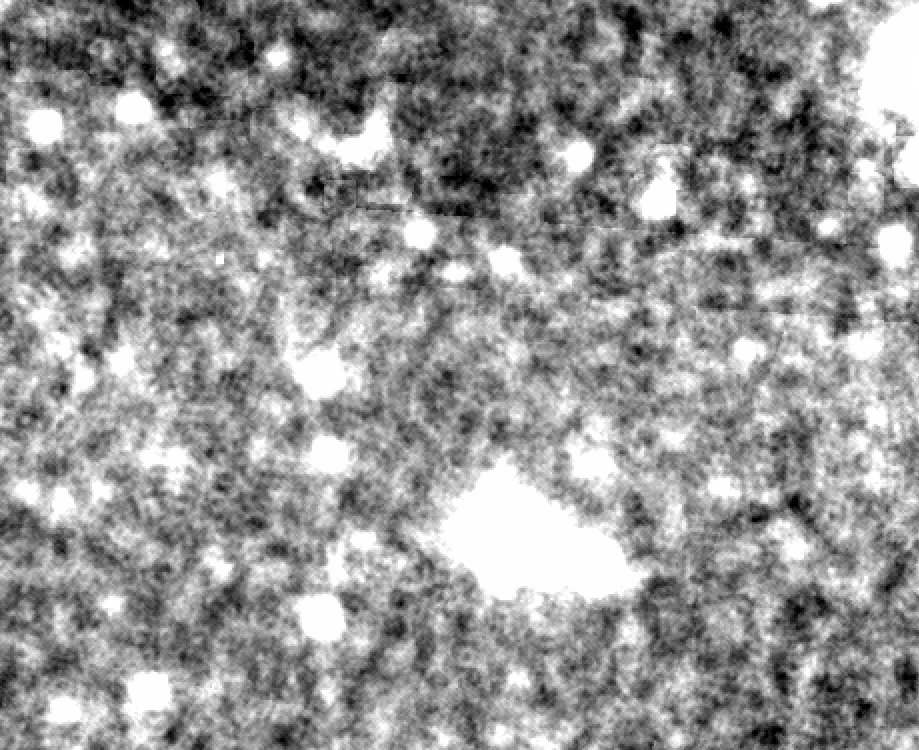
There are some significant flat-fielding issues, especially near the edges of the field. Zooming in, there are some strange re-sampling effects in the stack - these are going to seriously mess up faint-source science, for example in this zoom-in of a g-band stack from MD07 (cell 056):

I’m quite worried about the ‘chunky’ effect seen in (e.g.) the abrupt level changes, and the mottling effect. I’m guessing that all of these are a combination of convolution, dealing with NaN-ed regions in the input frames, and how the sky is dealt with. I’m trying to use the deep CFHTLS Groth Strip and EN1 (INT) images to figure out how much of that mottling is noise, and how much is contributed by faint galaxies - I hope to come up with something quantitative. We should be worried about that that.
More worrying: here is an example of a comparison of g and r-band stacks of skycell 030. Something seems to have gone quite badly wrong - especially with g. I suspect this is a masking issue - looks like something from a bright star has infected the image?

Finally, just looking at a few of the z-band warped images, there might still be an issue with correlated readnoise:

Not yet clear to me how much of an issue this is with the other filters, until we look at all of the data. Will do that in the next few days.
Object detection
The .cmf catalogue seems only to contain fairly bright (and mainly point-like sources). I ran Sextractor on the frame with a very simple 3-sigma / 5-pixel threshold (quite low, I admit - but I wanted to push it to see what came up). I got the following (red circles are Sextracted and green boxes are from the supplied cmf catalogue). Note - should the cmf catalogue have extended / faint sources in it? There might be some de-blending going on, because some of the big bright things have been split into two.

Depth/photometry and comparison to existing deep optical images
Here is an example of a side-by-side view of an r-band image of MD07, compared with the CFHTLS (Megacam) image. I've overlaid the positions and photometry from the CFHTLS so you can compare depths:

... and the same for MD08, compared to Subaru Suprimecam (i-band):

Of course, we don't expect the current MDS data to be as deep as these comparison frames yet (in fact, it looks like we're hitting r~24 at 5-sigma)... but the image quality should be something to aim for in order to be competitive in extragalactic studies.
You can see that (roughly) a 5-sigma detection is at about r=24 mag. Here is a plot showing the MDS instrumental mag (I’ve bootstrapped the z.p. from the CFHTLS deep catalogue) compared to the Megacam magnitude (note that the CFHTLS catalogue should be going down to r=28 mag). You can see where the scatter blows up at about r = 24 mags (I’ve shown two versions of the plot). This was only rough, I need to do something a bit more rigourous to work out the true depth. Also, this is for just one cell:

More to add...
Comparison with SDSS - (Nigel Metcalfe)
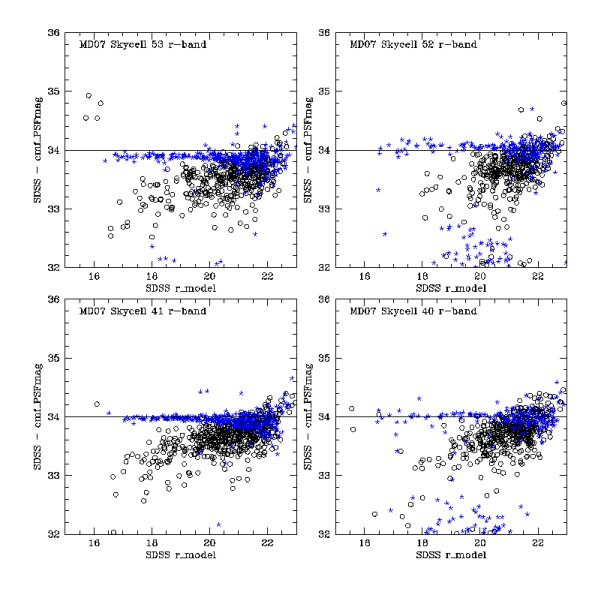
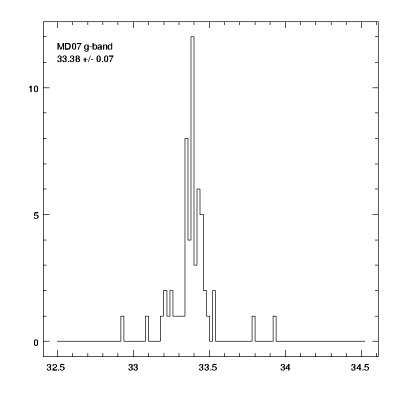
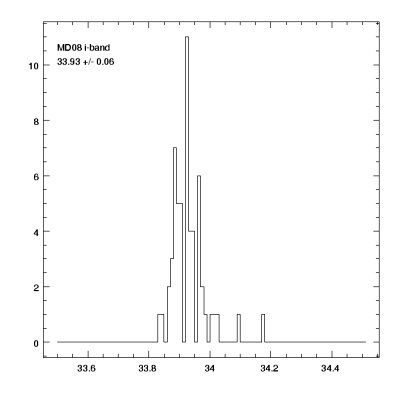
Here is a comparison of the PSFmags from the cmf files of four adjacent (arbitrarily chosen) MD07 stacks with SDSS model mags. r-band on the top left, g-band top right, i-band bottom left, z-band bottom right. Blue indicates an object flagged as a star by SDSS. I haven't rejected any images flagged as defective in any way, so this probably explains the blue points offset by 2 mags. UPDATE: looks like these offset points are stars with masked centres - note that there are brighter stars which are not masked. Is this the 'removing intermediate brightness stars as cosmic rays' problem again? It appears particularly bad on r cells 40 and 52.
Clearly the zero-point varies from cell to cell (do we expected this? after all, no calibration has been done as far as I can tell). The r-band stellar locus also appears tighter in cell 41 than in the other r-band cells. As the are no extended source magnitudes in the cmf files, all the galaxies (black open circles) are offset.


Here is a image of part of the above r-band mosaic of four stacks, with sextractor detections in green. Interestingly, the skycells have gaps between them (I thought they would overlap slightly?), and one of the cells has many more detections. The reason for the latter is not clear. The pixel-pixel noise and background levels are indistinguishable from the other three - the only difference appears to be in the structure of the background (Jim's mottling effect). Note also the dark halos around bright objects where the background subtraction has been too aggressive.

Attachments (37)
- example1.jpg (124.5 KB ) - added by 17 years ago.
- example2.jpg (166.1 KB ) - added by 17 years ago.
- g_and_r.jpg (1.1 MB ) - added by 17 years ago.
- readnoise.jpg (528.0 KB ) - added by 17 years ago.
- MD07_r_056_jeg_extract_with_PS1_extract.jpg (644.8 KB ) - added by 17 years ago.
- mds_cfhtls_rcomp.jpg (776.3 KB ) - added by 17 years ago.
- en1_iband_comparison.ti.jpg (541.2 KB ) - added by 17 years ago.
- flux_comparison.jpg (76.4 KB ) - added by 17 years ago.
- MD07_gband_sdss.jpg (68.5 KB ) - added by 17 years ago.
- MD07_rband_sdss_v2.jpg (67.2 KB ) - added by 17 years ago.
- MD07_mosaic_r_sex.jpg (234.7 KB ) - added by 17 years ago.
- MD07_iband_sdss.jpg (63.1 KB ) - added by 17 years ago.
- MD07_zband_sdss.jpg (68.8 KB ) - added by 17 years ago.
-
mosaic_deV.csv
(239.9 KB
) - added by 17 years ago.
SDSS deVaucouleurs parameters for skycells 40/41/52/53 on MD07
-
mosaic_exp.csv
(240.1 KB
) - added by 17 years ago.
SDSS exponential parameters for skycells 40/41/52/53 on MD07
-
mosaic_petro.csv
(241.2 KB
) - added by 17 years ago.
SDSS Petrosian paramaters for skycells 40/41/52/53 on MD07
- trailing3.jpg (517.1 KB ) - added by 17 years ago.
- trailing.jpg (385.2 KB ) - added by 17 years ago.
- gals_r_saturation.jpg (12.7 KB ) - added by 17 years ago.
- md08_077_comparison_stack.jpg (1.2 MB ) - added by 17 years ago.
- total_mask.jpg (368.7 KB ) - added by 17 years ago.
- masks.jpg (586.5 KB ) - added by 17 years ago.
- md07_g_zp.jpg (10.7 KB ) - added by 17 years ago.
- md07_r_zp.jpg (11.8 KB ) - added by 17 years ago.
- md07_i_zp.jpg (12.2 KB ) - added by 17 years ago.
- md07_z_zp.jpg (11.0 KB ) - added by 17 years ago.
- md08_g_zp.jpg (11.4 KB ) - added by 17 years ago.
- md08_r_zp.jpg (10.4 KB ) - added by 17 years ago.
- md08_i_zp.jpg (11.9 KB ) - added by 17 years ago.
- md08_z_zp.jpg (11.8 KB ) - added by 17 years ago.
- md08_stack_zeropoints (4.5 KB ) - added by 17 years ago.
- md07_stack_zeropoints (4.2 KB ) - added by 17 years ago.
- original.jpg (21.1 KB ) - added by 17 years ago.
- smooth_after.jpg (17.5 KB ) - added by 17 years ago.
- smooth_before.jpg (27.1 KB ) - added by 17 years ago.
- unsmoothed.jpg (98.2 KB ) - added by 17 years ago.
- contribution.jpg (21.6 KB ) - added by 17 years ago.