| Version 7 (modified by , 17 years ago) ( diff ) |
|---|
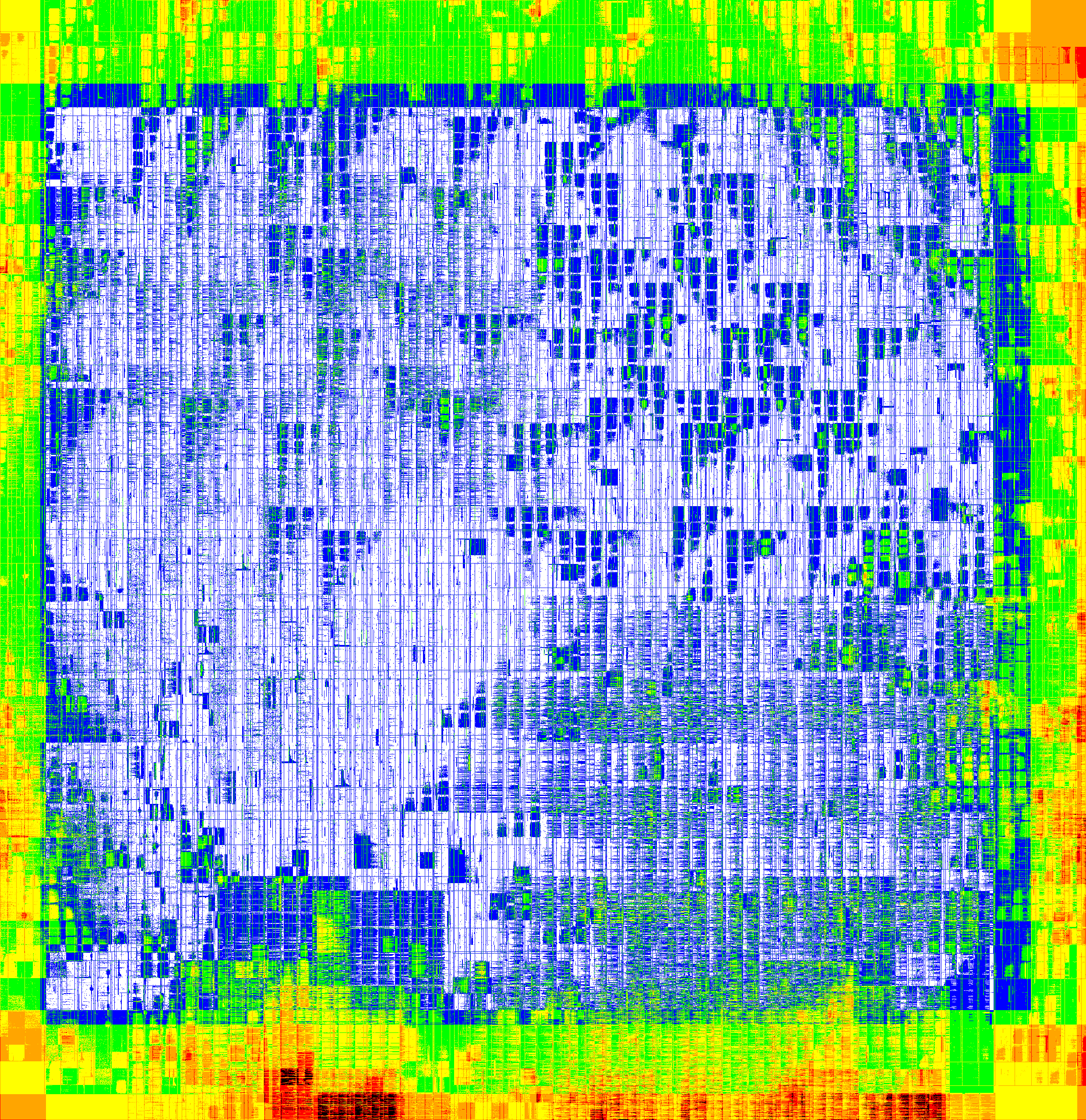
The current GPC1 camera is characterized by a several rectangular hot-spots of large dark current. These regions are unusable for science. This recent dark frame traces the location of these structures

In the images I have examined, typical dither patterns insufficiently remove this pattern; the inter-pointing offsets are on the order of a couple of arcminutes, while hotspots cluster on scales of several tens of arcminutes.
The image below shows the dither pattern used to image the Fornax cluster in 2008. In this six-pointing dither, regions with no contribution from bad pixels are coded white. Regions with 1-6 bad pointings are colored blue, green, yellow, orange, red, and black.

The above dark image can be used as a map of bad regions on GPC1; this information can be used in turn to engineer dither patterns which minimize the number of bad-pixel overlaps. One such dither pattern is shown here:

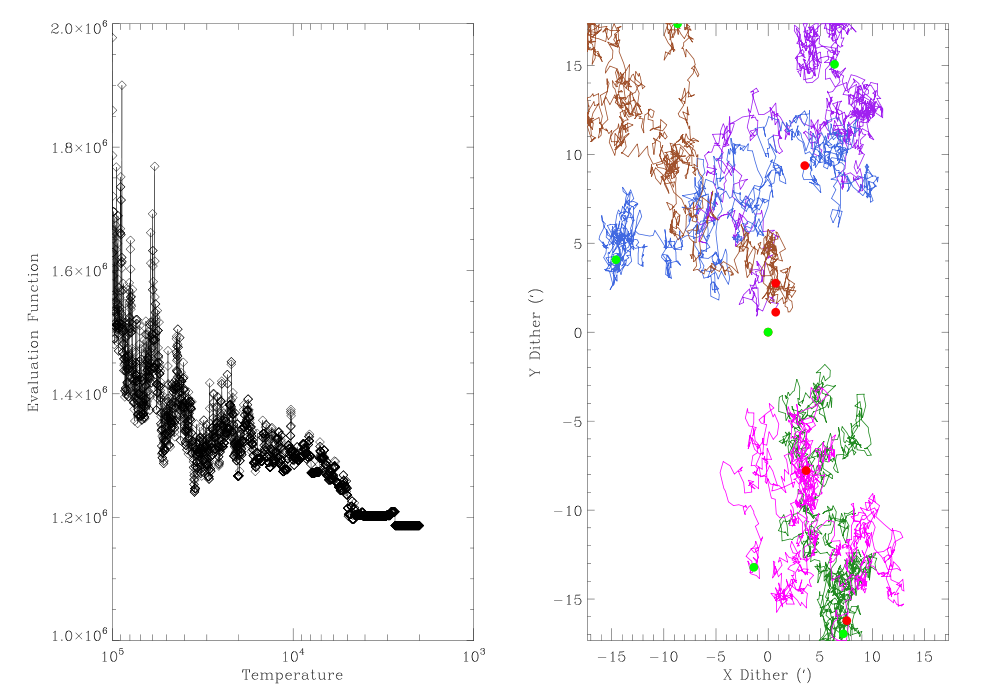
To construct it, I minimized the number of overlapping hotspots in the central 50% of the array. The minimization was achieved using a simulated annealing algorithm. The results of this are shown below. The left plot shows the evaluation function as a function of Temperature (or iteration); low values indicate minimal hotspot overlap. The right plot shows the position of the 6 dither offsets throughout the simulation (one dither point is constrained to lie at 0,0). The red points show the random starting dithers, while the green points show the final, optimized dither locations.

The pointings of this dither pattern are given by
N     dx (arcmin RIGHT)     dy(arcmin UP)
1       0                 0
2       6.371           15.052
3       7.225          -16.950
4     -14.594            4.070
5      -8.682           17.333
6      -1.368          -13.217
Attachments (5)
-
dark.1.jpeg
(1.5 MB
) - added by 17 years ago.
gpc1 dark exposure
-
dark.mask.jpeg
(1.3 MB
) - added by 17 years ago.
binary mask created from dark exposure
-
fornax_dither.png
(912.9 KB
) - added by 17 years ago.
Dither pattern for observations of the Fornax Cluster
-
anneal_3_dither.png
(989.8 KB
) - added by 17 years ago.
optimized dither pattern
- anneal.png (220.8 KB ) - added by 17 years ago.