| Version 5 (modified by , 13 years ago) ( diff ) |
|---|
Full Force Test on Small Area Survey Stacks and warps
This note discusses the results of the first test of the IPP full force stage on the SAS stacks (label = SAS.20130620). The label for the fullForceRun was SAS.20140117.
The purpose of this test were
- verify the basic operation of the software
- test the code on a well studied area of the Pan-Starrs survey
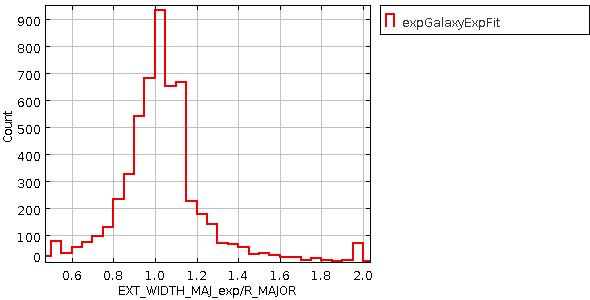
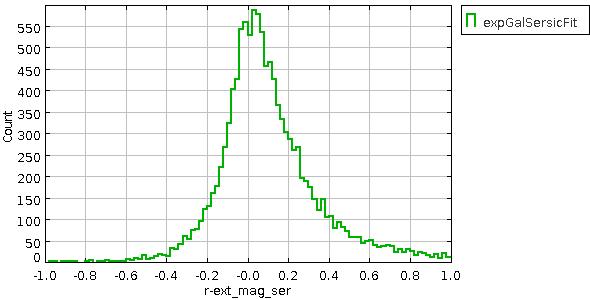
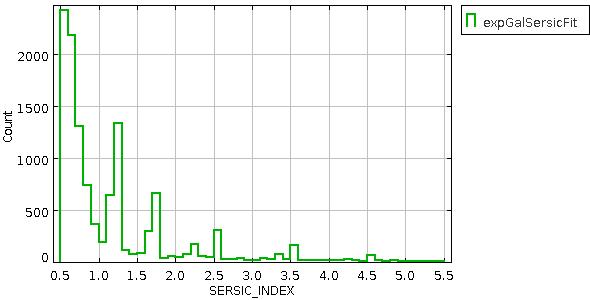
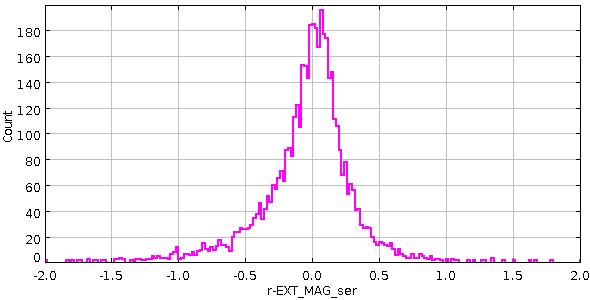
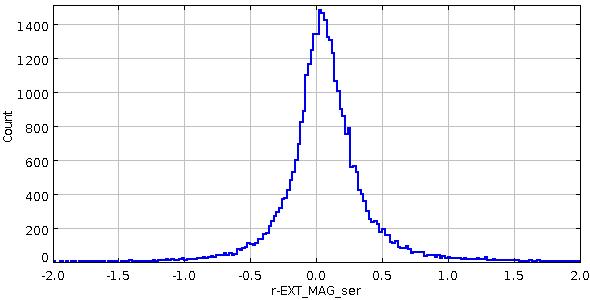
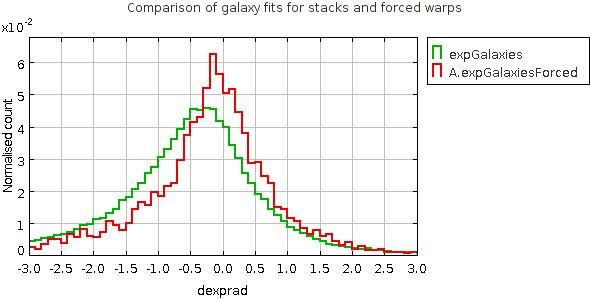
- compare the resulting galaxy model fits to SDSS measurements of galaxy parameters
- to determine the recipe parameters to be used in 3PI.PV2
Recipes
The programs and the algorithms used by the full force pipeline are described in fullforce_algorithms.
This test searched a wider range in fit radii parameters than is necessary or practical from a compute perspective. This was done so as to get an idea of the range that should be used for the 3PI analysis.
| Recipe Parameter | This Test | Default Value |
|---|---|---|
| GALAXY_SHAPES_FR_MAJOR_MIN | 0.5 | 0.85 |
| GALAXY_SHAPES_FR_MAJOR_MAX | 2.0 | 1.15 |
| GALAXY_SHAPES_FR_MAJOR_DEL | 0.05 | 0.05 |
| GALAXY_SHAPES_FR_MINOR_MIN | 0.5 | 0.85 |
| GALAXY_SHAPES_FR_MINOR_MAX | 2.00 | 1.15 |
| GALAXY_SHAPES_FR_MINOR_DEL | 0.05 | 0.85 |
With these parameters 961 trial galaxy fits were performed for each object selected for fitting. The average processing time for each warp was 960 seconds. This is prohibitively expensive for the 3PI survey. In fact we stopped the test after processing only 20% of the skycells because it was taking so long. We believe that this limited test provides the good enough statistics for analysis.
Data Set
The latest SAS stacks (label SAS.20130620) were processed through the staticsky and skycal stages of the IPP using the candidate PV2 version of psphot (tag ipp-20140114). These stacks were built with the warps labeled SAS.20130620. These warps are the target of the forced photometry measurements.
The code is essentially the same as that used for SAS_32 except that the selection of objects for extended model fitting in psphotStack was relaxed. In particular the previous requirement that the object be "extended" (EXTNSIGMA > 3) is not applied. Instead magnitude cuts were used.The cuts chosed are 21.5 in g, r, and i. 20.5 in z and 19.5 in y band. Note that these cuts are per object. If the object's magnitude was less than the cut for any band, fits were performed in all bands. In 3PI.PV2 extended model fits will not be performed in the region within 20 degrees latitude of the galactic plane with the limit increasing to 35 degrees near the galactic center.
During the skycal processing a new data product is produced. The "cff file". Here are contained the measurements for each source that are to be used for forced photometry. Each source with an with a extended source fit is marked for galaxy fitting.
The inputs to each "full force run" are the cff file (one per skycell per filter) and the set of individual warps for each skycell. In this data set there were on average 11 warps per skycell.
The full force processing consists of two parts. Running psphotFullForce on the individual warps followed by psphotFullForceSummary to generate the final extended source measurements for each source. See fullforce_algorithms for details on the measurements and calculations.
Attachments (23)
- dexpmag.jpg (20.4 KB ) - added by 13 years ago.
- dexprad.jpg (23.0 KB ) - added by 13 years ago.
- dexpmag_v_dexprad.jpg (57.7 KB ) - added by 13 years ago.
- rMajor_exp.jpg (23.2 KB ) - added by 13 years ago.
- dexpmag_v_r.jpg (36.5 KB ) - added by 13 years ago.
- dsermag.jpg (26.1 KB ) - added by 13 years ago.
- sersic_index_exp.jpg (21.7 KB ) - added by 13 years ago.
- dsermag_v_r.jpg (32.6 KB ) - added by 13 years ago.
- sersic_index_dev.jpg (28.5 KB ) - added by 13 years ago.
- ddevrad.jpg (21.9 KB ) - added by 13 years ago.
- ddevmag.jpg (19.8 KB ) - added by 13 years ago.
- ddevmag_v_ddevrad.jpg (44.8 KB ) - added by 13 years ago.
- ddevmag_v_r.jpg (38.5 KB ) - added by 13 years ago.
- rMajor_dev.jpg (25.0 KB ) - added by 13 years ago.
- dsermag_v_r_dev.jpg (42.3 KB ) - added by 13 years ago.
- dsermag_dev.jpg (25.1 KB ) - added by 13 years ago.
- dsermag_all.jpg (22.9 KB ) - added by 13 years ago.
- sersic_index_all.jpg (24.5 KB ) - added by 13 years ago.
- rMajor_ser.jpg (21.4 KB ) - added by 13 years ago.
- dexpmag_hist_comparison.jpg (28.6 KB ) - added by 13 years ago.
- dexprad_hist_comparison.jpg (27.7 KB ) - added by 13 years ago.
- ddevmag_hist_comparison.jpg (27.4 KB ) - added by 13 years ago.
- ddevrad_hist_comparison.jpg (27.5 KB ) - added by 13 years ago.
Download all attachments as: .zip