| Version 131 (modified by , 15 years ago) ( diff ) |
|---|
IPP to PSPS interface: ippToPsps
ippToPsps is the interface between IPP and PSPS. It creates FITS files generated from various IPP data-sources, then publishes them to a datastore in the form of batches. On the PSPS side, the DXLayer polls the datastore, collects batches when they become available, then converts the contents to csv files before sending them on to SQL Server loader software, which merges them into the PSPS database.
It is intended that the binary tables in the FITS files generated by ippToPsps match the PSPS database schemas perfectly, the consequence being that any alterations to the PSPS database schema will only affect ippToPsps code, and not the DXLayer. A certain amount of data validation is performed by ippToPsps before publication, with more validation occurring at the loading and merge stages on the PSPS side.
Simultaneously to loading data, ippToPsps polls PSPS to inquire after the status of the batches it has loaded. Batches that failed can then be reloaded. The status of every batche is maintained in a MySQL database local to ippToPsps.
The outputs of ippToPsps are referred to as 'batches', and are detailed below.
| Batch name | PSPS name | Description | IPP Source |
| Initialization | IN | metadata relating to other batches, eg filter ID, survey ID etc | generated from XML config |
| Detections | P2 | single exposure detections | generated from one smf file per exposure plus associated DVO database
|
| Stack | ST | stack image detections | one FITS file generated per IPP cmf, which contains data for one filter on one skycell
|
| Difference | ? | difference image detections | generated from one cmf file per skycell per exposure
|
Configuration
Due to the potential for changes in both input and output for ippToPsps, rather than hard-coding table descriptions, the code is heavily configurable. As such, the tables descriptions are stored as VOTable files (for example), which are a standard of the IVOA. Because VOTables are an XML format, they both human and machine readable, expandable and self-describing. These VOTables are generated directly from the PSPS schema using a script, so that any changes to the schema can be easily passed-along to ippToPsps.
Additionally, a more general configuration file is used to detail the names of databases, location of output files, datastore settings etc. This can be seen here
Architecture
ippToPsps is written in Jython, this is in part to take full advantage of the STILTS package, which enables very fast and efficient processing of astronomical catalog data tables. Since it supports FITS, VOTable, and SQL, it is a perfect fit for this project. It is also software maintained elsewhere, reducing this burden for us.
Design
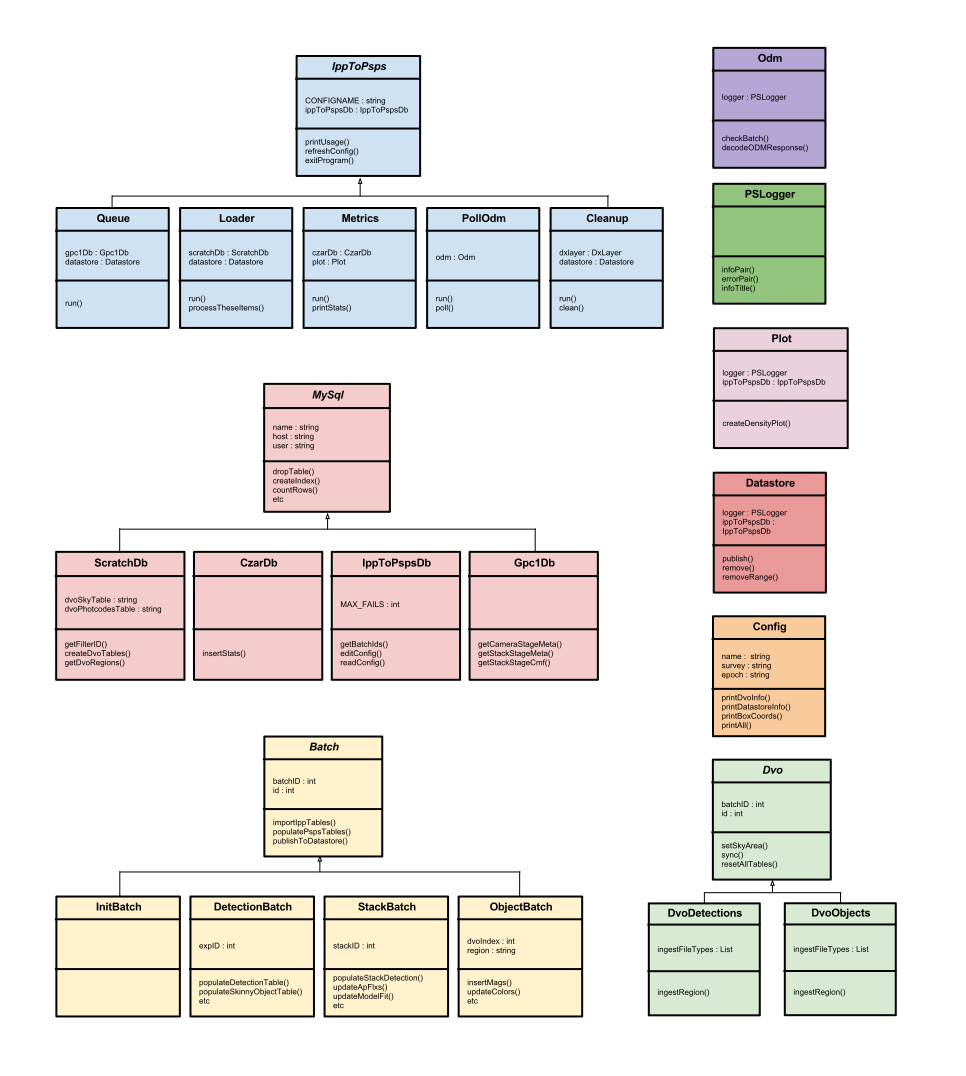
Each batch type (detection, stack, init etc) is its own class, all of which inherit from the Batch base-class, which handles features common to all batches, such as creating and opening output FITS files, connecting to the GPC1 database, connecting with the DVO database etc. This keeps duplicated code at a minimum. The Batch class is an abstract class, i.e. it should not, and cannot, be instantiated.
Each class has a single header file and a single source file. Public fields and methods are visible in the class (struct) definition in the header. Private members and functions are declared as static in the associated source files, thus keeping them encapsulated. All class code is contained in a single C file. Methods are accessed via function pointers in the structure.
Running
Notes on how to run ippToPsps can be found on the individual batch-type pages, linked to at the top of this page.
Deletion policy
When loading, two copies of the data exist: the batches on the datastore and the original files on disk. The deletion policy at present is:
- when a batch has been loaded to the ODM and has a status of 'merge worthy', then the copy on the datastore is removed
- when a batch has been successfully merged into the PSPS database, the copy on local disk is deleted
The logic for this is that errors may occur during the merge phase and it is useful to have local copies of offending batches for debugging purposes.
Unit testing
Unit tests exist for all batch types in the unitTests folder. These tests confirm that data integrity is maintained after code changes have been made. All batch tests can be run like this
cd unitTests
./runAllTests.sh
Or, individual test like this, for detections:
cd unitTests/detectionTest
./run.sh
All test create batches in a 'test' mode, meaning, a current date will not be used and, in the case of detections, only chip 33 (instead of all 60) will be processed. The resultant FITS files are then compared (using diff) with FITS files known to be correct. The user is informed if they are identical or if they differ.
Recovery system design
Currently, the IPP to PSPS interface is a 'one-way' system. Batches are created by ippToPsps and posted on an IPP instance of the datastore. These batches are collected by the DXLayer on the PSPS side and sent on to the ODM. The IPP urgently requires some feedback from PSPS to determine which batches have succeeded and which have failed (and why they failed). With this information, data can be either deleted or regenerated accordingly. This is important simply because, with such large data volumes, we cannot afford the high levels of redundancy currently in place. At present, for a given batch, the following copies exist within the pipeline:
- a copy exists on the IPP cluster after generation by ippToPsps program
- a copy exists on the IPP datastore after publication by ippToPsps
- the
DXLayerretains a copy after it has sent the csv version to the ODM - the
DXLayeralso keeps a copy of these (larger) csv files
We therefore need to quickly implement the basic framework of a feedback loop so that the IPP can quickly learn if a given batch has been successfully merged into the PSPS database or not. This will enable it to safely delete the data files and remove the copy from the datastore. This will also form the basis for a more comprehensive recovery system, to be developed at a future date.
Previous design
                                              .............................
                                             .   ___________               .
                                             .  |           |              .
         ---------------------------------------| datastore |              .
        |                                    .  |___________|              .
 .......|...........................         .       /|\                   .
.  ____\|/_____       ___________   .        .    ____|____        _____   .
. |           |      |           |  .        .   |         |      |     |  .
. | ippToPsps |----->| datastore |-------------->| DXLayer |<---->| ODM |  .
. |___________|      |___________|  .        .   |_________|      |_____|  .
.                                   .        .                             .
 ...................................         ..............................

               IPP                                       PSPS
Previously, Conrad and I had discussed a design whereby a second datastore instance would be utilized, this time on the PSPS cluster. The DXLayer would act as the 'middle-man', polling the ODM for updates on loading progress, then posting the results on the PSPS datastore for the IPP to consume. Polling this, ippToPsps could acquire a list of batches it knows are safe to be discarded. Simultaneously, the DXLayer could delete its copies of the same redundant data.
The update placed on the PSPS datastore could take the form of an XML file. At first this would simply detail those files it is safe to delete, but could evolve into a more complex recovery report, i.e. which batches failed, and what is required to be done by the IPP.
New design
         ------------------------------------------------------------
        |                                                            |
........|...........................          .......................|.....
.  ____\|/_____       ___________   .        .    _________        __|__   .
. |           |      |           |  .        .   |         |      |     |  .
. | ippToPsps |----->| datastore |-------------->| DXLayer |----->| ODM |  .
. |___________|      |___________|  .        .   |_________|      |_____|  .
.                                   .        .                             .
 ...................................         ..............................

               IPP                                       PSPS
Instead of creating a new datastore instance within PSPS and using the DXLayer as communication layer between the ODM and the IPP, we propose that the DXLayer forms no part of the feedback system. It should be simplified such that it only facilitates loading, i.e. polling the IPP datastore for new data, converting it to csv files then sending these on to the ODM. Instead, to complete the circle, the ippToPsps code will poll the ODM directly, bypassing the DXLayer altogether. This also forms the basis of a full recovery system as, at a later date, ippToPsps can be coded to respond intelligently to the myriad of errors that may occur within the ODM. The DXLayer need know nothing of the how or why a certain batch is being submitted by the IPP, it should just grab it, convert it and pass it along to the ODM.
This design would therefore mean simplifying a major PSPS component, the DXLayer, but rather than waste the code already written, it would be taken and used within ippToPsps (for example, the ODM polling scripts). We would simply be shifting responsibility over from PSPS to IPP. Over parts could be dropped completely. For example, since ippToPsps will (soon) keep a record of all the jobs and corresponding exposure IDs in the IPP database, it is unnecessary for this information to be duplicated by the DXLayer, which currently has its own local database for this information.
The question remains of what should be done with the copies of the data currently retained by the DXLayer? The options are that it can either be deleted automatically after a defined amount of time, or the IPP can send a list of batches it is safe to delete through the datastore, or perhaps the DXLayer should not retain files at all. Since it can quickly and easily acquire data from the IPP datastore anyway, it is probably unnecessary for it to hold any copies.
Advantages over previous design
- no need for second datastore (not a big overhead, but it would require additional systems administration in an already complicated system)
- no need to define new XML standard that incorporates the whole array of recovery options
- no need for the
DXLayerto poll the ODM - no need for the
DXLayerto have a database to log the batches (already done on the IPP side) - no need for the
DXLayerto keep data at all?
links
Datastore test area for PSPS on Maui
Datastore test area for PSPS at JHU
current loading summary
Attachments (2)
- new3pi_P2_2012_0308_135938.png (5.4 KB ) - added by 15 years ago.
- ipptopspsclassdiagram.svg (791.2 KB ) - added by 15 years ago.
Download all attachments as: .zip